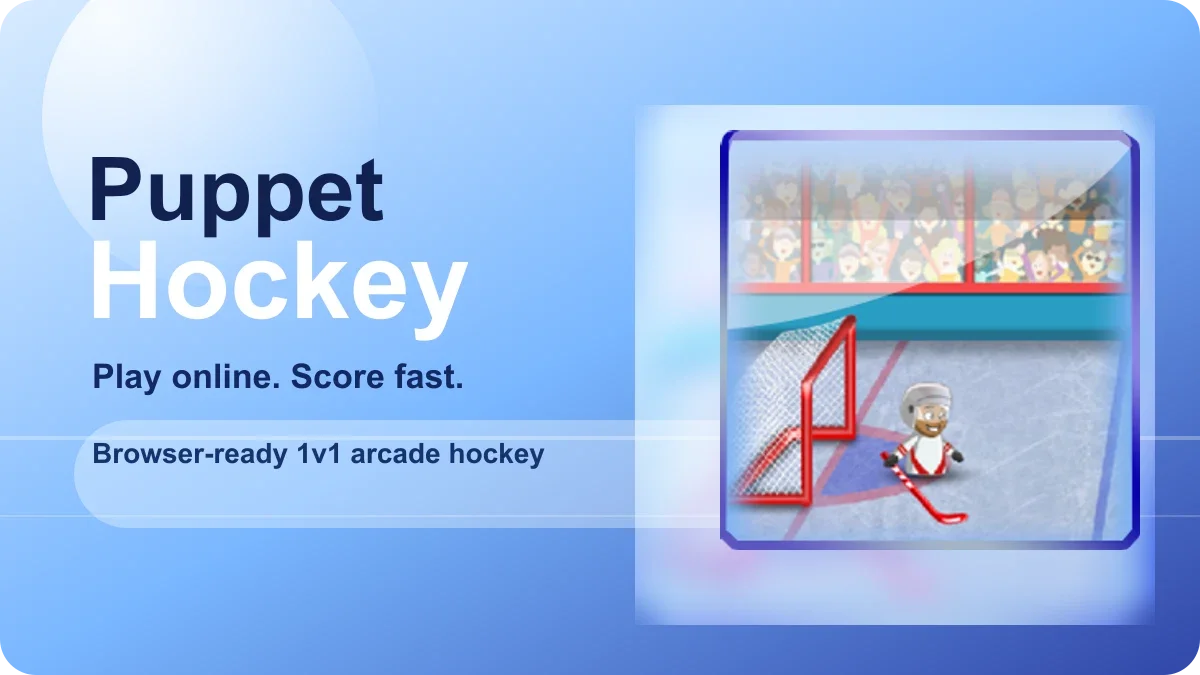
Puppet Hockey

Rating:
4.48
Played:
11,365
Puppet Hockey Turns One Bounce Into a Goal
Puppet Hockey is a fast browser sports game built around short one-on-one hockey matches, oversized puppet players, and rebounds that can change the score in a second. Instead of chasing realism, it leans into arcade chaos. Your skater has a giant head, the puck flies at strange angles, and even a messy save can become a counterattack if you react quickly enough. That mix makes each round feel lively from the opening faceoff to the final horn.
The basic objective is simple: score more goals than your opponent before time runs out. The interesting part is how unstable every possession feels. The puck can pop upward off a body check, slide under a jumping player, or ricochet straight back toward goal after a blocked shot. Because matches are brief, one mistake matters, but one smart touch matters just as much. You understand the goal immediately, yet it still takes practice to control pace, spacing, and shot timing.
Browser Sessions That Start Immediately
This web version is easy to approach because it removes the usual friction. You do not need a long tutorial, a large install, or a complicated menu before the action begins. Open the page, load the match, and you are already in a quick contest where every rebound asks for a decision. Puppet Hockey feels best when you can jump in, play a few rounds, learn from the last bounce, and start over without delay.
If you already know you want that kind of fast sports game, Puppet Hockey is a natural place to start because the browser build loads quickly and keeps the focus on instant play. On BlockCrush, the same appeal carries over well. You can launch a match on desktop or mobile, test a few aggressive angles, and settle into the rhythm of short rounds that never overstay their welcome.
That short-session structure also makes improvement feel satisfying. You do not have to invest half an hour before learning something useful. One round teaches you that staying underneath a falling puck is safer than chasing it from behind. Another shows that a soft touch toward open space can beat a hard swing directly into the defender. The game keeps sharpening timing skill and quick reflexes through these small lessons, which is a big reason players return for one more match.
Timing Matters More Than Wild Button Mashing
At first glance, the movement looks silly enough that you might assume constant jumping is the answer. It usually is not. Good play comes from arriving early, facing the right angle, and choosing when to challenge the puck. When you throw your puppet upward at every chance, you often drift out of position and leave your own net exposed. When you stay patient, you can meet the puck cleanly and send it where the opponent is not.
Desktop flow
On desktop, you will usually move with the keyboard and trigger jumps or shots with a second key. Exact mappings can vary by build, but the feel stays consistent: move into the puck, jump to contest high bounces, and strike when the opening is there. The important habit is to read the puck before you read the opponent. The player model is large and funny-looking, but the puck is still the real source of danger. If you track it early, your defense becomes calmer and your attacks start from better positions.
Mobile feel
On mobile, the same ideas matter even though the input surface changes. Touch play is convenient for short rounds, but it can feel a little less precise during frantic goalmouth scrambles. That does not mean mobile is worse. It simply rewards cleaner decisions. Instead of trying to win every challenge with speed, focus on blocking the obvious lane, nudging the puck away from your net, and taking controlled shots when the opponent lands awkwardly.
A helpful beginner rule is this: stay close enough to threaten the puck, but not so close that every bounce goes over your head. That spacing gives you room to react. It also makes it easier to turn defense into offense, because a controlled stop in front of goal often becomes a quick shot before the other puppet resets.
Winning More 1v1 Rounds
Most improvement in Puppet Hockey comes from three practical adjustments. First, stop treating every contact as a shooting chance. Some touches should simply move the puck into a safer area. Clearing danger to the side is often smarter than blasting the puck straight up the middle. Second, learn to shoot across the goal instead of always at the nearest opening. Cross-goal angles are harder to block, especially after the defender jumps too early. Third, notice the moment after a rebound. That instant is when many goals happen, because both players are slightly off balance and the puck is hardest to predict.
There is also a mental side to short rounds. Because matches move quickly, players often tilt after one unlucky goal and start forcing attacks. The better response is to reset immediately. The game is built on chaos, so a strange bounce is not a sign that the round is lost. One clean block or one well-timed jump can erase the deficit almost as fast as it appeared.
If you want a simple practice plan, spend a few matches focusing on defense first. Try to concede fewer soft goals from rebounds near your own net. Once that feels steadier, switch your attention to shot selection. You will start to notice that not every open puck should be hit at full force. Sometimes a compact touch aimed into empty ice is the most dangerous play on the rink.
From NOXGAMES Mobile Roots to Web Play
Puppet Hockey has recognizable roots in the broader big-head sports style that became popular on mobile. Google Play lists Puppet Hockey: Pond Head from NOXGAMES and describes it as a cartoon hockey game with slapshots, body checks, exaggerated characters, and optional two-player play on one device. That background helps explain why the browser version feels the way it does. The game is not trying to simulate professional hockey systems or detailed team strategy. It is trying to create readable, funny, high-energy moments that work in short bursts.
The browser format keeps the strongest part of that formula. You still get fast matches, oversized movement, and a constant sense that the puck might do something awkward or brilliant on the next touch. That is exactly why the game remains appealing online. It is easy to understand, expressive to play, and dramatic even when a session lasts only a few minutes.
Common Questions
Is Puppet Hockey realistic?
No. It is much closer to an arcade sports game than a hockey simulator. The physics are exaggerated, the characters are cartoonish, and short rounds matter more than detailed tactics.
Can I play Puppet Hockey online without downloading anything?
Yes. The browser version is designed for instant play, so you can start a match online without a traditional install process.
Does the game work better on desktop or mobile?
Both are playable, but desktop usually feels more precise when you need quick saves, cleaner angles, and sharper reactions during crowded rebounds.
Which beginner habit helps most?
Focus on puck tracking before fancy attacks. Stay between the puck and your goal, challenge high bounces with purpose, and look for cross-goal shots instead of random swings.
Why do I keep giving up easy goals after I jump?
That usually happens when you jump too early and drift out of the play. Try waiting a fraction longer so you contest the puck at contact instead of flying past it.
Who made Puppet Hockey?
The mobile release most commonly associated with the game is Puppet Hockey: Pond Head by NOXGAMES, which helps explain the series' big-head style and quick-match design.



Comments
Loading comments…