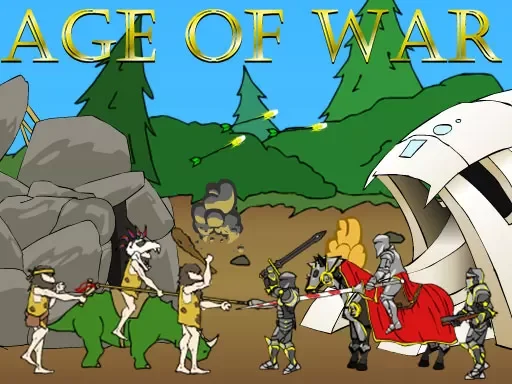
Age of War


Rating:
4.41
Played:
14,129
Age of War at a glance
Age of War is a lane-based arcade strategy game about surviving long enough to outgrow the enemy in front of you. You begin with rough early units, build income, and work toward stronger eras that unlock better troops and heavier tools. The whole loop is easy to read in seconds, but the decisions keep changing because every purchase affects your next few moments on the lane.
The version on this site keeps that classic structure inside the browser, so you can load the match and start immediately without a download. If you want the direct browser version right now, Age of War opens the familiar setup in one tab and keeps the action centered on a single screen.
What makes the match grow over time
The best thing about Age of War is how clearly it escalates. Early units are cheap and useful because they buy time, soak pressure, and let your economy recover. Later units are slower to afford but much stronger, so the game becomes a race between careful spending and the next big upgrade. That shift gives every minute a different shape, even though the battlefield never changes size.
Progress is not only about throwing out more units. You also need to think about when to save, when to spend, and when to hold resources for the next age change. If you empty your gold too early, you may survive a small moment but lose the larger arc of the match. If you wait too long, the opponent can build enough pressure to force awkward buys and break your rhythm.
How the browser version plays in practice
The browser build is straightforward to control. On desktop, the mouse is enough for almost everything: click the unit buttons, buy whatever support tools are available, and trigger the age-up option when you can afford it. On mobile, taps do the same job. The interface matters because the game is built around visible choices, not hidden menus or complicated commands.
That simplicity is part of the appeal. You do not need to memorize a long input list before the game becomes fun. Instead, you learn the rhythm of the lane, watch which purchases create breathing room, and notice how quickly the board changes after each age shift. Once the basics click, each run becomes a small lesson in timing and pacing rather than raw speed.
Reading gold, XP, and age changes
Gold is the resource you spend most often, so it is the first thing to protect. XP, on the other hand, matters because it pushes you toward the next age and opens stronger options. Many new players focus only on the immediate fight and forget that an age change can be more valuable than several weak purchases. In Age of War, getting to the next era on time is often the real win condition.
The trick is to treat the economy as part of the battlefield. Small units are useful when you need a quick buffer, but they are not a reason to stop thinking about the bigger plan. If the lane is stable, saving for the next era usually pays off more than making one more low-impact buy. That is where the game starts to reward patience, because the strongest turns are rarely the fastest ones.
Better habits for longer runs
Try not to spend just because you can. A stronger run usually comes from a deliberate purchase that changes the state of the lane, not a stack of random clicks. If the enemy is still far from your side, keep enough resources in reserve so the next age change does not stall. If the enemy gets close, buy something that buys time, then return to saving. That balance is what keeps the match from collapsing early.
Special abilities are at their best when the lane is already crowded and a single burst can swing the tempo. Use them too early and you only get a small pause. Use them at the right moment and they can clear space for a counterpush or a cleaner age-up window. The same rule applies to support tools: value them for what they change, not just for how quickly they can be clicked.
Another useful habit is to watch the opponent's pattern instead of staring only at your own bar. Age of War becomes easier once you notice that the other side often telegraphs its strength spikes. When that happens, a modest defensive spend can be smarter than chasing a flashy push. Skilled play here is less about perfect execution and more about choosing the right trade at the right moment.
Why the original still matters
Age of War became memorable because it turned a simple side-scrolling layout into a long arc of escalation. The original release is tied to Louissi and is widely dated to 2007, which places it deep in the Flash era. That context matters because the design feels built for quick restarts, immediate clarity, and the kind of short sessions people used to play between other tabs. It is an arcade strategy game where skill matters as much as timing.
Even now, the idea still works because the rules are so readable. You are never wondering what the next click means. It is either more pressure, more income, or a better future age. That clarity is why the game survived long after its original web era changed. The loop is simple enough for a first try, but the ceiling is high enough to make another run feel justified.
FAQ
Is Age of War free to play here?
Yes. You can play it in your browser on this site without installing anything first. The page loads the game directly, so starting a new run is fast.
How do I win?
Your goal is to keep your side alive while building enough momentum to reach stronger ages before the opponent does. If you can keep the lane under control and keep improving your economy, your run lasts much longer.
Do I need fast reflexes?
Not really. Timing matters, but Age of War rewards planning more than twitch reactions. A calm spend at the right time usually beats a fast but careless one.
How do I improve quickly?
Save for age changes, spend on units that actually change the lane, and use support tools when they create real space. If you keep making small, efficient choices, the match tends to snowball in your favor.
Can I play on mobile?
Yes. Touch controls work naturally because the game mostly asks for taps on visible buttons. Desktop is often easier to read, but mobile is still very playable.
Why do I lose after a strong start?
Strong starts can disappear if you overspend early and delay the next age. The game punishes short-term thinking, so a good opening still needs a plan for what comes after it.
Is this the same classic browser game people remember?
It follows the same core idea: build, upgrade, and outpace the other side in a lane-based match. That is why it still feels familiar even when you return after a long break.




Comments
Loading comments…