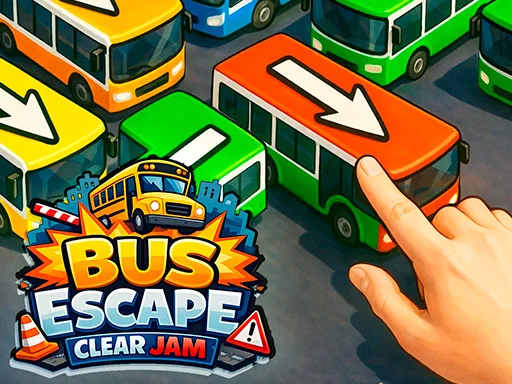
Bus Escape





Rating:
4.31
Played:
10,607
What Is Bus Escape
Bus Escape is a browser puzzle game where you sort color coded passengers onto matching buses, clear blocked lanes, and solve a crowded station one careful move at a time.
At first glance the objective looks easy: send waiting people onto the right bus and clear the jam. The catch is that the station is packed, buses arrive in a constrained order, and the wrong decision can block the route for the next few turns. That combination gives the game a steady puzzle rhythm instead of a pure reflex challenge.
The best way to think about Bus Escape is as a traffic sorting game with queue management. Each group of passengers wants a matching bus, and every boarding decision changes what becomes possible after that. A level can feel stuck for a moment, then open up once one lane clears. That chain reaction is the heart of the experience. You are trying to restore order by reading the board correctly.
Why The Loop Stays Engaging
Many browser puzzlers rely on spectacle, but Bus Escape works because its loop is readable. You can see the problem, test an idea, and understand why it failed. That makes improvement feel earned. Short rounds also help. One attempt rarely lasts long, so it is easy to retry with a better plan instead of feeling punished by a mistake made several minutes earlier.
How To Play Bus Escape On This Site
On the current site, Bus Escape runs directly in the browser through an embedded HTML5 build. You do not need a download or account to begin. Wait for the game to load, study the passenger colors and bus positions, then start moving people in an order that frees space instead of creating more congestion.
The core interaction is straightforward. You select or direct passengers so they board the bus that matches their color. Clearing one bus opens room for the next move, and that extra room often decides whether the whole puzzle remains manageable. The browser format suits the game because levels are easy to restart and improvement comes from quick re-reads rather than long runs.
Controls And What They Mean In Practice
Desktop play is usually mouse based. Click the passengers or the relevant target area according to the build, and the game sends them toward their matching bus if the route is available. Precision matters less than decision quality. You are choosing the correct sequence.
If two valid moves are available, the stronger move is often the one that removes an obstacle for future colors instead of merely finishing the most obvious group first. Early in a level, inspect which buses are boxed in and where a temporary opening could create a larger cascade.
A Good First Minute Routine
Start by identifying the most blocked color rather than the easiest color. New players often grab the first obvious match, only to discover that they used up precious space and trapped the harder section behind it. A better approach is to scan the entire station, notice which buses have the fewest access points, and protect those lanes before they disappear.
It also helps to look for chain reactions. If boarding one small group unlocks a second bus and that second bus clears the lane for a third, the value of the first move is much higher than it appears.
Common Mistakes That Create A Bigger Jam
The most common error is playing only one move ahead. Because each bus occupies space, every partial solution affects the rest of the board. Clearing a visible match can still be wrong if it leaves another bus stranded behind a crowd with no path to reach it.
Another mistake is ignoring color distribution. If one color appears in several separated pockets, that color may become the bottleneck later. Treat scattered groups with respect, because you may need to preserve access from multiple angles before you can finish them cleanly.
Players also lose momentum when they restart too late. Once the board becomes severely tangled, forcing random moves rarely saves the run. If two future colors now compete for the same blocked space, resetting early is usually smarter than digging deeper into a bad sequence.
Strategy For Consistent Clears
Reliable Bus Escape play comes from balancing local fixes with board wide planning. Strong runs solve something now while also increasing the number of possible moves afterward.
A useful mental model is to treat open spaces as resources. Empty lanes, freed bus slots, and newly accessible passenger clusters are all forms of value. A move that clears only one color but opens two new paths can be stronger than a move that looks more complete on the surface.
If a stage introduces tighter layouts, slow down even more. Harder levels usually ask you to notice which order prevents dead ends.
Where Bus Escape Fits In The Genre
Browser listings identify this version as Bus Escape: Clear Jam, published by Mirra Games on HTML5 portals. The concept sits in the same broad family as sorting and traffic jam puzzlers, but the bus station theme gives it a more readable sense of flow. Instead of shuffling abstract pieces, you are managing lines of people and vehicles.
That theme also explains the appeal. The board looks crowded, the problem is immediately understandable, and every successful move makes the scene visibly calmer.
FAQ
What is the main goal in Bus Escape
Your goal is to clear the station by guiding passengers onto the correct color matched buses in an order that prevents blockages and eventually removes the traffic jam.
Is Bus Escape more about speed or planning
Planning matters more. The game is readable and usually rewards players who pause to study the layout, protect open lanes, and think a few moves ahead before making a selection.
How do I get better at difficult levels
Focus on the most constrained buses first, watch for chain reactions, and value space creation over quick visible matches. If a run becomes obviously tangled, restart early and test a different opening order.
Can I play Bus Escape without installing anything
Yes. This site serves the game in the browser, so you can load the page and start playing without a separate app installation.
Why do some levels feel impossible at first
They usually hide an order problem rather than a control problem. One early move often determines whether the rest of the layout opens smoothly or locks into a dead end.
What makes Bus Escape satisfying compared with other sorting games
It gives clear visual feedback. Each correct decision reduces crowding, opens a new route, and makes the whole station easier to read, so progress feels concrete instead of abstract.
A Better Way To Approach Your Next Run
Bus Escape becomes much more enjoyable once you stop treating every visible match as urgent. Read the station, protect room for the hardest color groups, and aim for moves that create options instead of only solving the nearest problem.







Comments
Loading comments…